Custom Apparel
Where should a logo go on an embroidered polo?
A practical Austin guide to embroidered polo logo placement, artwork choices, proof checks, and timing.
Where should a logo go on an embroidered polo?
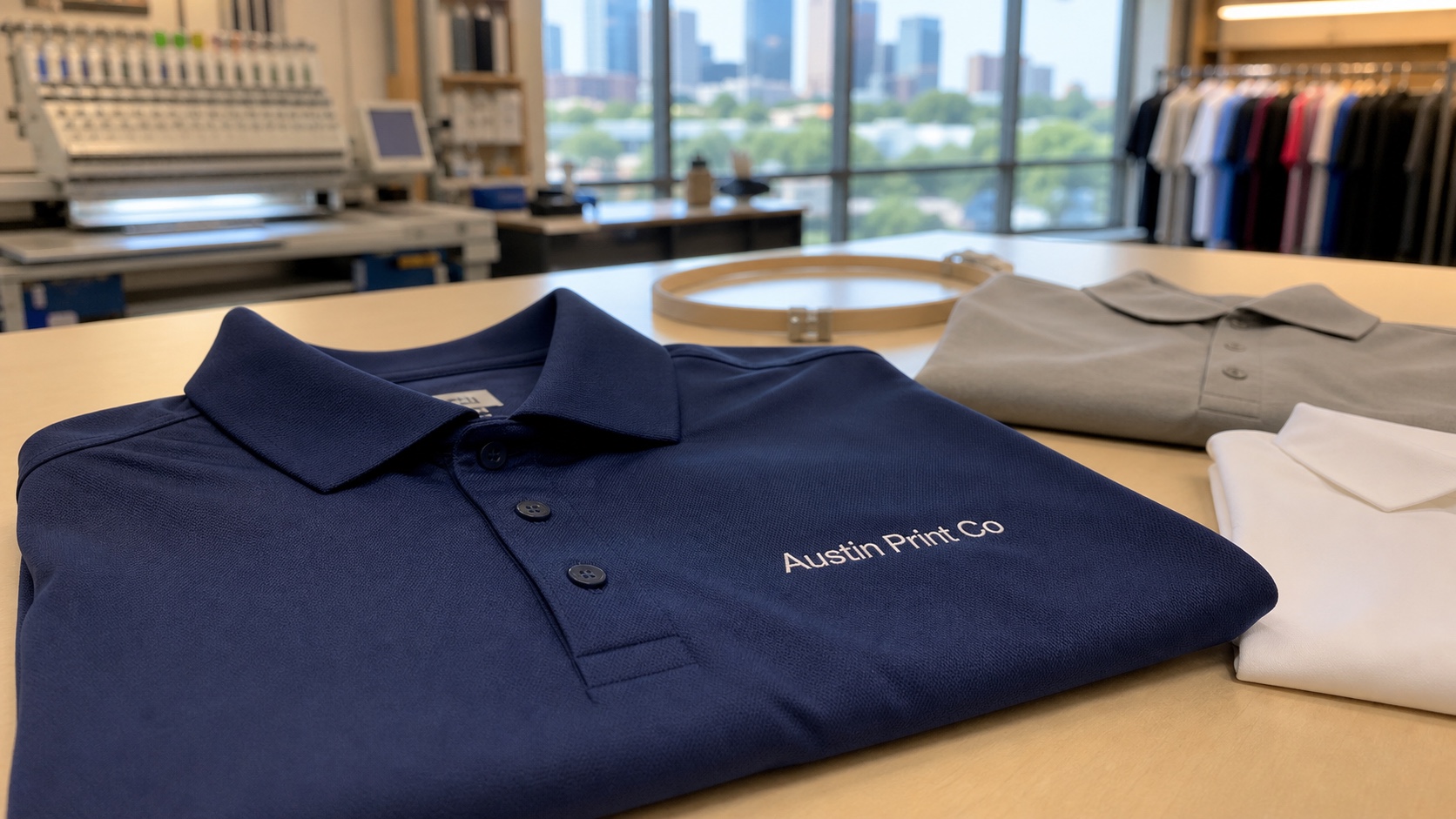
A left-chest logo is the default placement for an embroidered polo because it stays visible in conversation, works with most logos, and does not fight the placket. The right size depends on the artwork and garment, but the goal is a clean mark that sits below the collar and inside the chest panel, not a patch that takes over the shirt.
For Austin teams ordering polos for staff, sales calls, events, or client-facing work, placement is usually decided after the garment and logo have been chosen. A detailed horizontal logo may need a different treatment than a compact badge, and a lightweight performance polo behaves differently from a heavy cotton pique.
Where should a logo go on an embroidered polo?
Most embroidered polo logos go on the wearer's left chest, a few inches below the collar seam and clear of the placket. That placement reads as intentional, leaves room for the fabric to move, and gives a name or secondary mark a predictable place on the other side if the program needs one.
The first proof should show the logo on the actual polo style, not on a flat blank rectangle. Polos have collars, plackets, seams, buttons, and sometimes pockets. Those details change what looks centered.
Why left chest is the usual choice
Left chest is familiar because it works. A logo there is easy to see without turning the shirt into a billboard, and it suits employee uniforms, golf polos, hospitality apparel, and sales-team gear.
It also gives a company room to use the rest of the garment well. A sleeve can carry a small event mark. The opposite chest can hold a short name or role. A back yoke can work for certain crews. Those are secondary decisions. Put the main brand mark in the place people expect first.
Match the logo shape to the decoration area
A tall, compact icon often stitches neatly at left chest. A long wordmark can get too small to read if it is forced into the same space. In that case, a simplified mark, stacked version, or short company name may produce a better embroidered result.
Fine lines, tiny type, gradients, and close color changes need a real artwork review before production. Embroidery is thread, not ink. The digitized file tells the machine where each stitch goes, so the design has to account for fabric stretch, stitch direction, and the detail that will survive at the final size.
At Austin Print Co, artwork is reviewed before production and a digital proof shows placement and scale. That is the point to flag a wordmark that is too wide, lettering that will close up, or a logo that should move slightly to clear a placket.
Keep the mark small enough to look like apparel
The best polo logo is usually easy to notice, not impossible to ignore. Oversizing a chest design can pull lightweight fabric, make the collar area feel crowded, and turn a clean uniform into a promotional shirt.
Ask to see the intended dimensions on the proof. A small difference can matter when the design includes lettering. If the order includes several polo brands or men's and women's cuts, confirm that the placement is adjusted for the garment rather than copied from one template.
Choose the garment before you lock placement
A classic pique polo, a slick performance polo, and a workwear polo do not provide the same embroidery surface. Seams and stretch panels can limit placement. A pocket polo needs a different plan. Some performance styles need stabilizer and a lighter stitch approach so the mark stays tidy.
Send the supplier style or a link with your quote request. If you have a favorite polo from a prior order, include a photo of the logo placement you want to repeat. That saves the back-and-forth that happens when someone says "standard left chest" and everyone pictures a slightly different spot.
For broader garment options, see custom apparel in Austin. If the program includes caps as well as polos, custom hat embroidery has different sizing and placement rules.
When a sleeve or back placement makes sense
A sleeve logo can work for a sponsor, department, event, or short secondary mark. It has less room than most people think, so a busy logo often needs to be simplified. Back-yoke embroidery is better for short text or a small mark than for a dense full-color-style logo.
Large back designs usually call for another decoration method. For example, a full-color graphic may be better suited to DTF printing in Austin than dense embroidery. A print partner should recommend the method based on the artwork, garment, quantity, and how the shirts will be used, not force every job into one process.
Give your print shop the details that prevent a bad proof
A useful polo quote request includes the logo file, quantity, garment preference, sizes, left-chest or alternate placement, thread colors if they are set by a brand guide, and your in-hands date. Vector artwork is ideal, though a clean high-resolution file can still be reviewed.
If timing is tight, say so early. Rush availability depends on the polo stock, quantity, artwork readiness, and production schedule. A simple repeat job may move faster than a first run that needs garment sourcing and digitizing.
Get a polo proof before you commit
A proof is where the order stops being abstract. Check the logo's distance from the placket, whether the design stays inside the usable chest panel, thread colors, and the spelling of any small type. If there are multiple logo versions floating around your company, send the approved file rather than asking the shop to choose one.
Need polos for a sales team, restaurant staff, office uniforms, or an Austin event? Request a custom quote from Austin Print Co with the garment, quantity, artwork, and deadline. We will confirm what fits the job and what timing is realistic.
FAQ
How big should an embroidered polo logo be?
The right size depends on the logo shape and garment, but it should remain legible while fitting cleanly within the left-chest panel and away from the placket and seams.
Can a company logo go on the right chest of a polo?
Yes, a right-chest placement can work when it suits the uniform design or leaves the left chest for a name, role, or another approved mark.
Do I need a special file for embroidered polos?
Your print shop will create or review a digitized stitch file, and vector artwork such as AI, EPS, SVG, or PDF usually gives them the best starting point.
Can small text be embroidered on a polo?
Small text can work if the lettering remains open at the final stitch size, but very fine type may need to be enlarged, simplified, or moved to a different decoration method.
How fast can embroidered polos be produced in Austin?
Timing depends on garment availability, quantity, artwork, and the production schedule, so share your in-hands date early and ask which rush options are feasible.
Need custom branded merchandise for your Austin team?
Request a quote from Austin Print Co — embroidery, screen printing, DTF, promotional products, and onboarding kits.
Request a quote